October 17, 2026
Quizlet Learn Alternatives: What to Use for Your Own Notes
By Keanu, founder of Quizzify · October 17, 2026
If you want a free Quizlet Learn alternative for drilling flashcards, start with Knowt. If you want practice questions built from your own lecture notes, with scored feedback on written answers and a review schedule that follows those scores, try Quizzify. Anki suits students who want full control over a long-term flashcard collection. RemNote suits students who want their notes and cards in the same place.
You may not need to switch at all. If your course sets are already in Quizlet, it can grade written answers by meaning (on eligible sets), explain mistakes and schedule flashcard reviews.
To find out where the two apps actually differ, I gave Quizlet and Quizzify the same short note on electrical circuits. Then, during practice, I gave both the same deliberately wrong answer, which mixed up the rules for series and parallel resistance. Both apps rejected it, explained the mistake and brought the question back. The difference was in the workflow. Quizzify shows a a percentage score, the explanation and a next-review interval together inside the quiz. Quizlet explains the mistake when you select Explain this, and it handles scheduled review in a separate Flashcards mode where you rate your own recall. not unlike Anki.
Quick picks: which Quizlet alternative fits?
| If you want… | Choose | Trade-off |
|---|---|---|
| Free Learn-style practice on your own flashcards | Knowt | AI features have separate free limits |
| Practice questions from lecture notes, with scored written feedback and automatic score-based review | Quizzify | Generation and written grading use weekly credits |
| A long-term card collection with custom layouts and review settings | Anki | You build or import the cards; there's no ready-made Learn path |
| Notes and flashcards in one workspace | RemNote | A note system to learn; AI allowances vary by plan |
| To keep using good sets from your teacher or classmates | Stay with Quizlet | Check you can access the study modes you need |
Should you stay with Quizlet?
Before you switch, work out which part of Quizlet you're actually unhappy with. Several features people leave for are already there:
- Learn builds a personalised study path around a flashcard set, with a mix of question types and an option for written answers.
- Relaxed grading can accept the meaning of a written answer, including rephrasing and synonyms, for eligible sets and languages. If an answer that meant the same thing was marked wrong, check this setting before changing apps.
- Spaced Repetition in Flashcards(currently web only) schedules cards from your own recall ratings.
- Practice Tests can generate exam-style questions from your notes or sets. Access depends on age, language and region as well as plan.
Access is the other thing to check. Quizlet's free student access guide says logged-in students invited and added to a teacher-managed class can use Learn and Test free on sets the teacher has added, when they open those sets from the class page. The class must be managed by a teacher account with admin permissions. Ask your teacher for a class invite and open the sets through that class before you pay for anything.
If my teacher had already organised the course in Quizlet, the sets matched the syllabus and the available modes covered the practice I needed, I'd stay. Switching has a cost: you have to move your material, check it again and learn a new routine.
Quizzify makes more sense when you start from a lecture file or a page of notes rather than a set, and you want each answer scored and that score to decide when the question comes back. It isn't a copy of Learn's study path.
How I tested
- Input: the same 404-character note in both apps. It covers Ohm's law, two 6-ohm resistors in series and in parallel, current and power. The input notes were correct and deliberately short and simple.
- Quizlet account: a fresh free account.
- Quizzify account: a fresh free account.
- A deliberate mistake: for the parallel-resistance question, I typed “12 ohms because the two resistors add together.” The correct answer is 3 ohms.
Quizlet and Quizzify compared
| Quizlet | Quizzify | |
|---|---|---|
| Starting from notes | Made eight flashcards from my note. AI Practice Tests accept notes or sets but rejected this sample | Generates a question deck from text or supported files |
| Guided study | Learn adapts a study path around a set | Practice questions with feedback, retries and scheduled reviews |
| Written answers | In Learn and Practice Tests, subject to eligibility | AI-scored, with written feedback |
| Meaning-based grading | Relaxed grading, for eligible sets and languages | Feedback assesses the response against the question and answer |
| Explaining a mistake | “Explain this” gave a personalised explanation in my test | Explanation included with the score |
| Same-session retry | Learn repeated my missed card | Both missed questions came back |
| Scheduled review | Web Flashcards, based on your own recall ratings | Dynamic scheduling based on performance |
| Free access | Limited Learn and Practice Tests; free Learn and Test on qualifying teacher-managed class sets (see conditions above) | 100 credits a week: 30 per generation, 1 per written evaluation |
The Quizlet column combines my test with its Learn, grading, Spaced Repetition and Practice Tests help pages, checked October 17, 2026. Offers vary by account, so check Quizlet's upgrade page for yours.
Quizlet: caught the mistake and explained it when asked
From the pasted note, Quizlet generated eight term-and-definition cards. I checked the preview before saving, and the cards were consistent with the note. I confirmed the set was private, with visibility set to Just me.
Relaxed grading still rejected the wrong rule
Learn was available in this session. I switched to written questions, left the default Relaxed grading on and typed the deliberate mistake for the parallel-resistance card.
Quizlet rejected it, showed the correct 3-ohm definition and labelled the result Relaxed grading applied. An I was correct override was also available. Relaxed grading didn't mean accepting an answer that was conceptually wrong.
Selecting Explain this gave a correct explanation of the series-versus-parallel mix-up. It used a highway-lanes analogy to show why adding parallel paths lowers resistance.
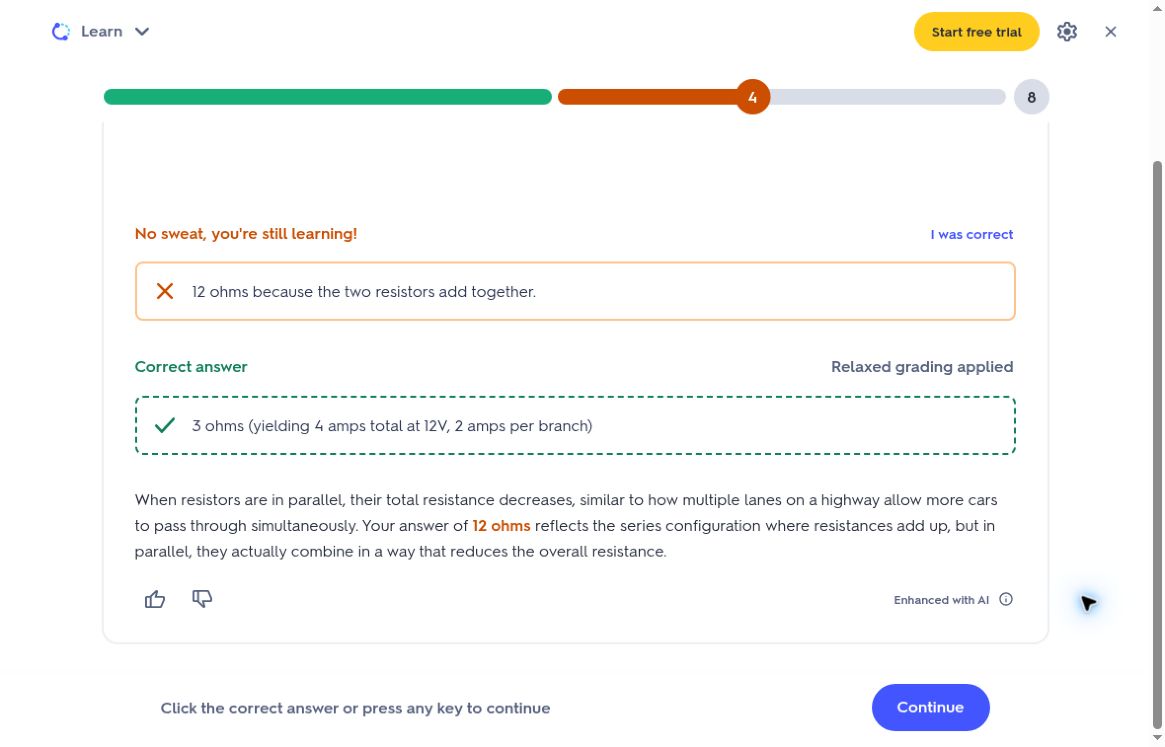
The same deliberately wrong written answer in Quizlet Learn. “Explain this” added the explanation below the correction in this fresh free-account session.
The difference from Quizzify was the order. Quizlet showed the correction first and the explanation when I asked for it; Quizzify included the explanation in its written evaluation. Both identified the misconception. If you were planning to leave Quizlet because you thought it only checks exact wording or can't explain a wrong answer, that wasn't the case in this test.
Learn showed a free-round limit and repeated the missed card
The first written round ended at seven of eight correct, with the message “4 free rounds left for this set.” When I continued, Learn brought back the parallel-resistance card with “Let's try again.” I answered 3 ohms and explained that two equal resistors in parallel have half the resistance of one branch. Learn accepted the answer.
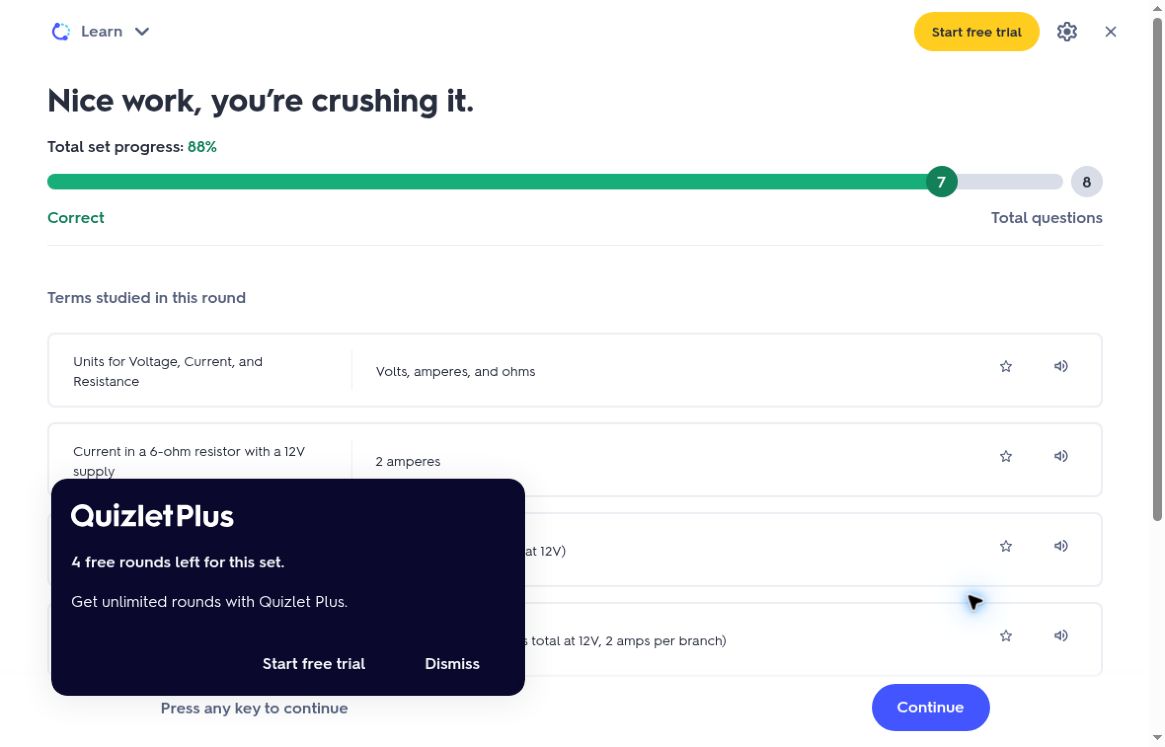
The limit shown after this account's first written round. I didn't use up the remaining rounds or test when the allowance resets.
The completion screen said I'd studied all the terms, but it didn't show a dated future review. So I moved to Flashcards to check Quizlet's separate scheduling.
Flashcards: self-rated spaced repetition
With Spaced repetition sorting selected, the day's plan showed zero cards to review and eight new cards. After flipping a card, I could rate it Repeat, Hard, Okay or Easy. The first intervals shown were up to one minute, up to five minutes, up to ten minutes and four days.
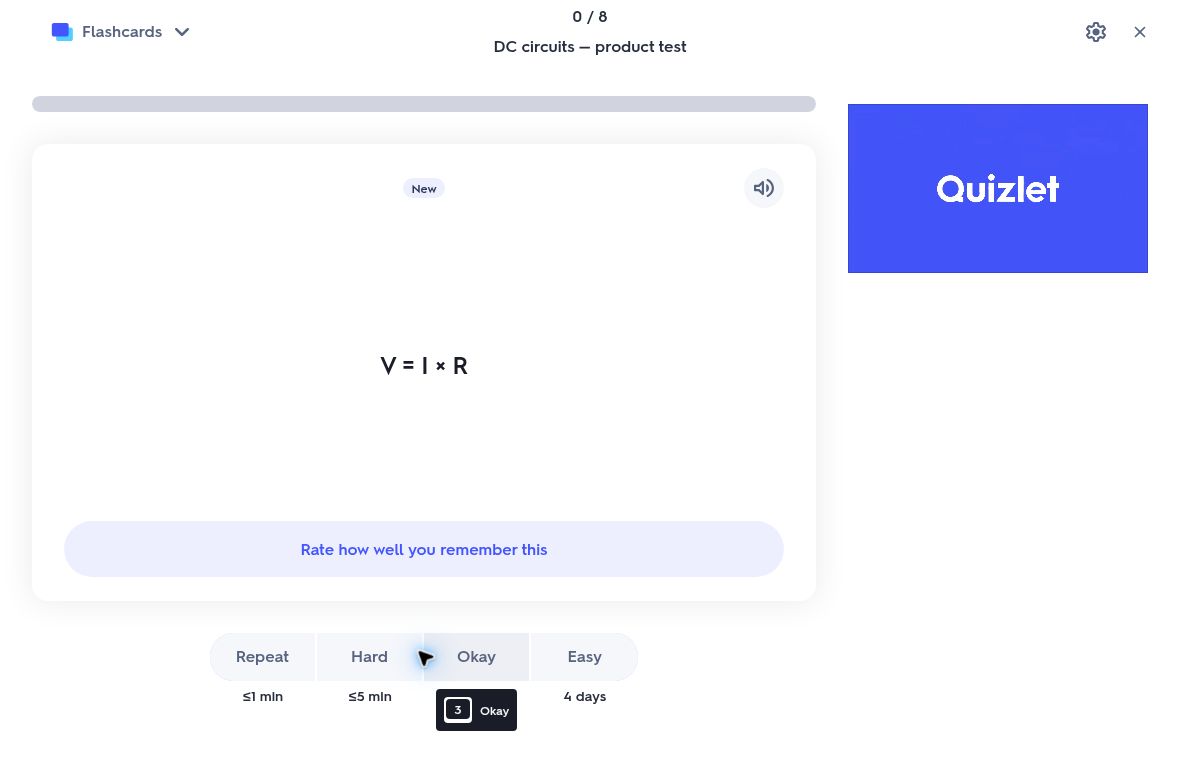
Quizlet's self-rated scheduling was available on the free account. A hover tooltip partly covers the Okay interval in this screenshot.
I rated three cards I knew as Easy, and each one showed Back in 4 days. I stopped at three of eight and didn't wait for any card to come due. Still, the review controls and intervals were there on a free account.
Practice Tests rejected this note
I pasted the same note into Quizlet's AI Practice Tests generator. It returned an unsupported-subject error and asked for material from a sciences or humanities course.
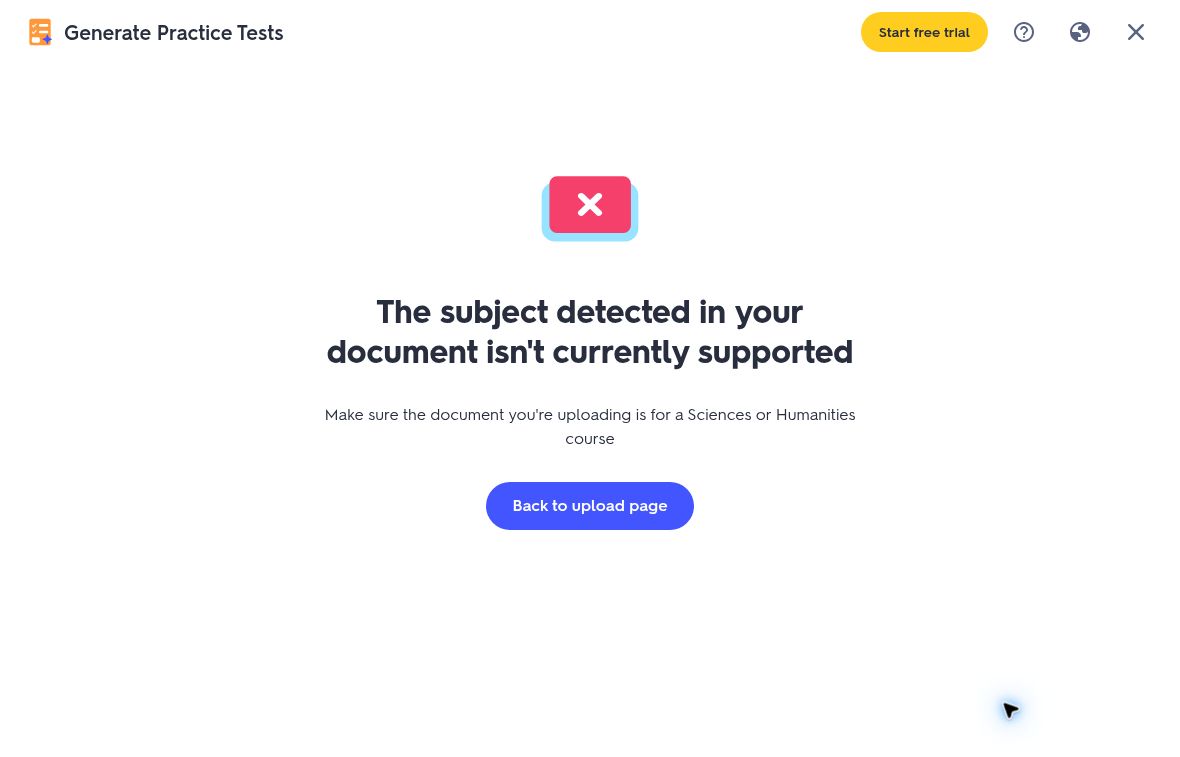
The Practice Tests error on this specific 404-character input. Flashcard generation from the same note had already worked.
I didn't retry with a longer or reworded source. That makes this one failed attempt, not evidence that Quizlet can't handle physics, and the error wasn't a subscription gate. Quizlet documents Practice Tests as supporting exam questions from notes. I just couldn't judge a generated test from this sample.
Quizzify: a score and a review date on every answer
I pasted the same note into Quizzify and left the optional special-instructions field empty. It generated eight cards: three multiple choice, two written, two true/false and one matching. I completed all eight and checked each answer key against the note, and all were consistent with it. That's a good result for one short input, but it isn't an accuracy rate for other subjects or longer files.
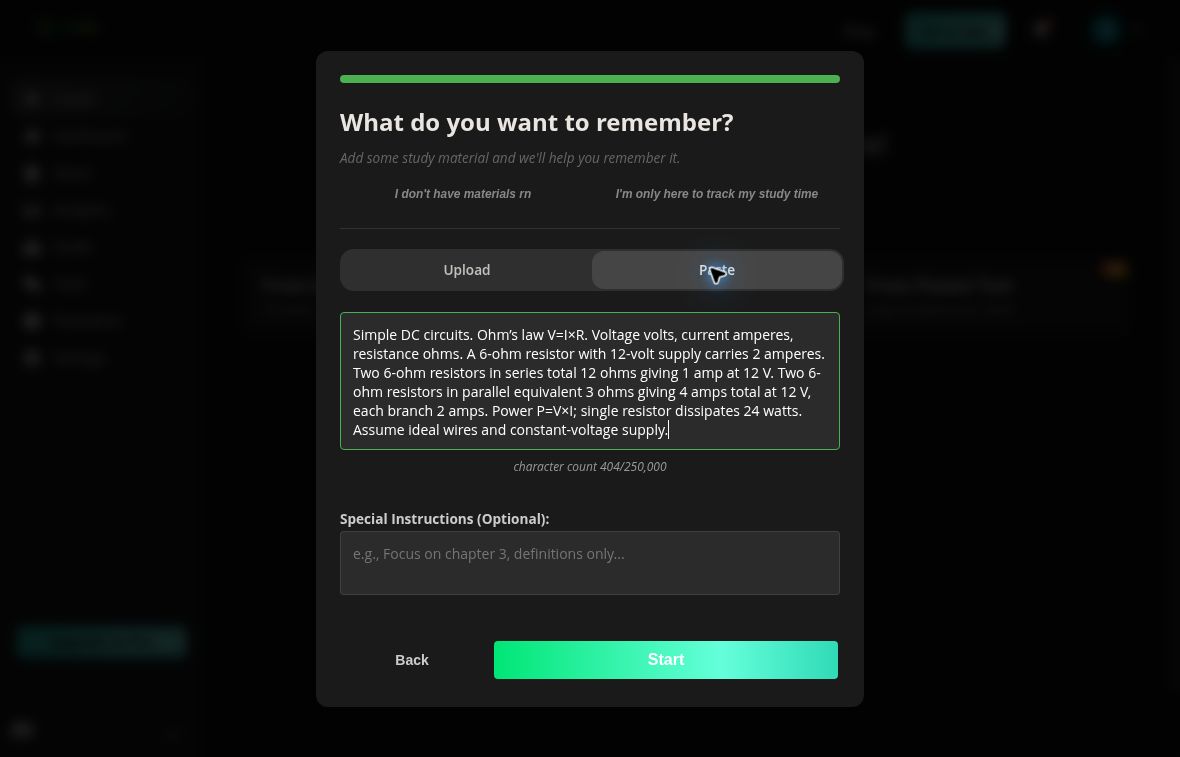
The actual input in this test: a short pasted note, with the optional special-instructions field left empty.
A wrong answer: 0%, one day and a retry in the same session
My first deliberate mistake was on a multiple-choice question about two 6-ohm resistors in series. I chose 3 ohms instead of 12 ohms. Quizzify scored it 0%, explained that series resistances add to 12 ohms and displayed a review interval of one day.
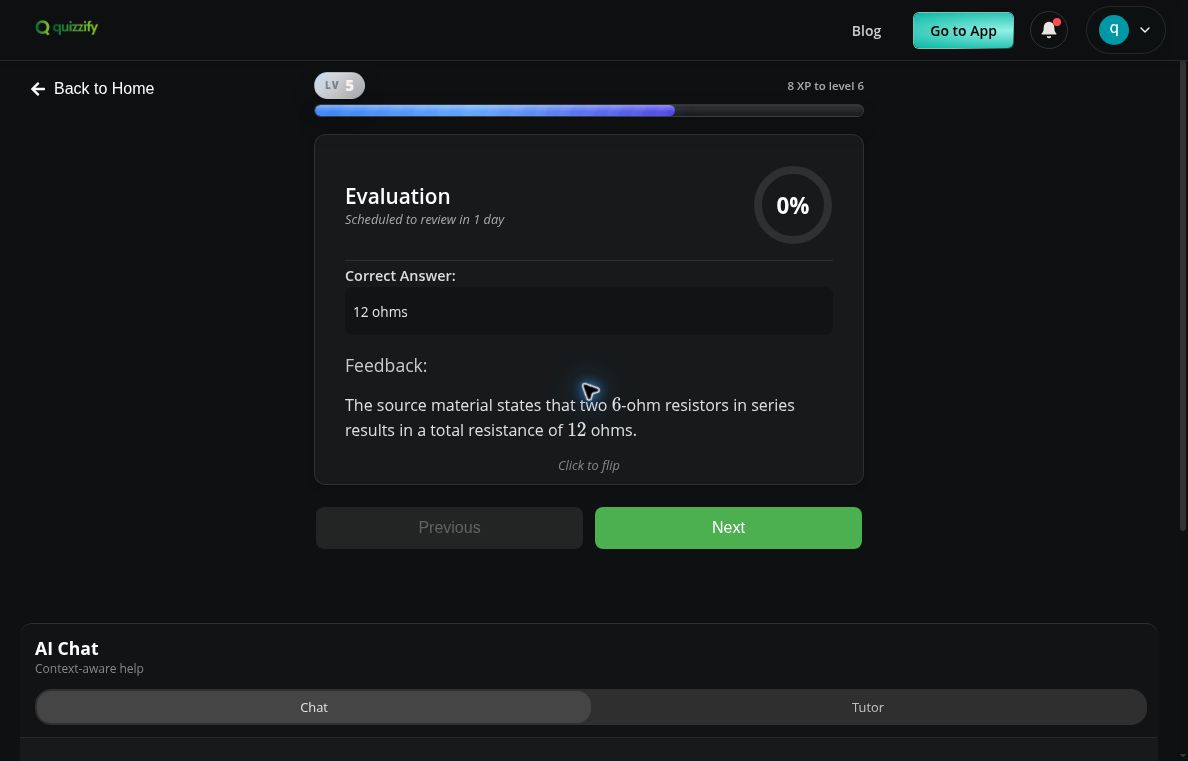
Recreated test on October 20, 2026, showing 0% and a one-day review interval; this is not the original October 17 session screenshot.
The session queue grew from eight cards to nine. At card five, the question came back with a prompt to try again. So the mistake got a retry in the same session as well as a later review date.
A correct answer: 100% and three days
I answered the parallel-circuit current question correctly with 4 amperes. Quizzify scored it 100% and displayed three days until review. The feedback tied the answer back to the note: two 6-ohm resistors in parallel give an equivalent resistance of 3 ohms, so 12 volts drives a total current of 4 amps.
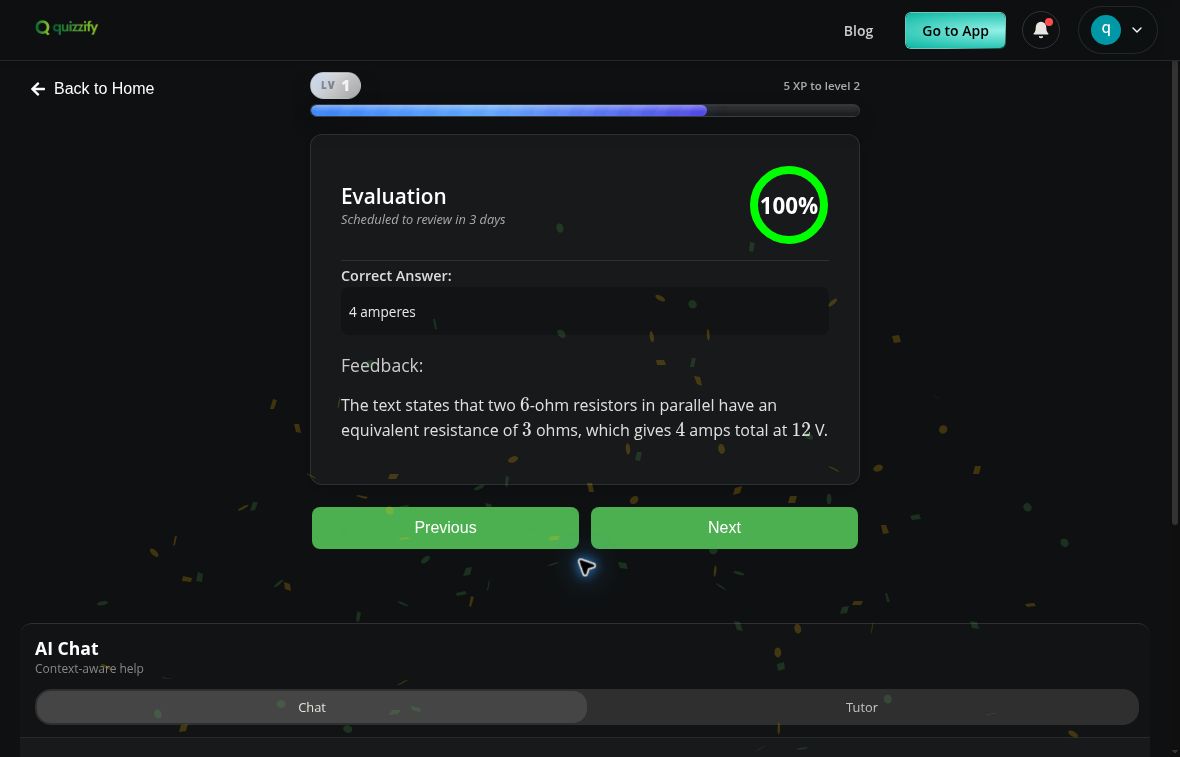
A correct answer received a three-day interval in this session; the wrong answer received one day.
The written mistake: 20% and the rule I'd mixed up
On the written parallel-resistance question, I typed the same answer I'd given Quizlet. Quizzify scored it 20%, showed 3 ohms as the correct answer and named the error: I'd applied the series rule to a parallel circuit. It explained that adding parallel paths lowers equivalent resistance. Then it split the feedback into what I'd understood and what needed improvement. This question also got a one-day review interval.
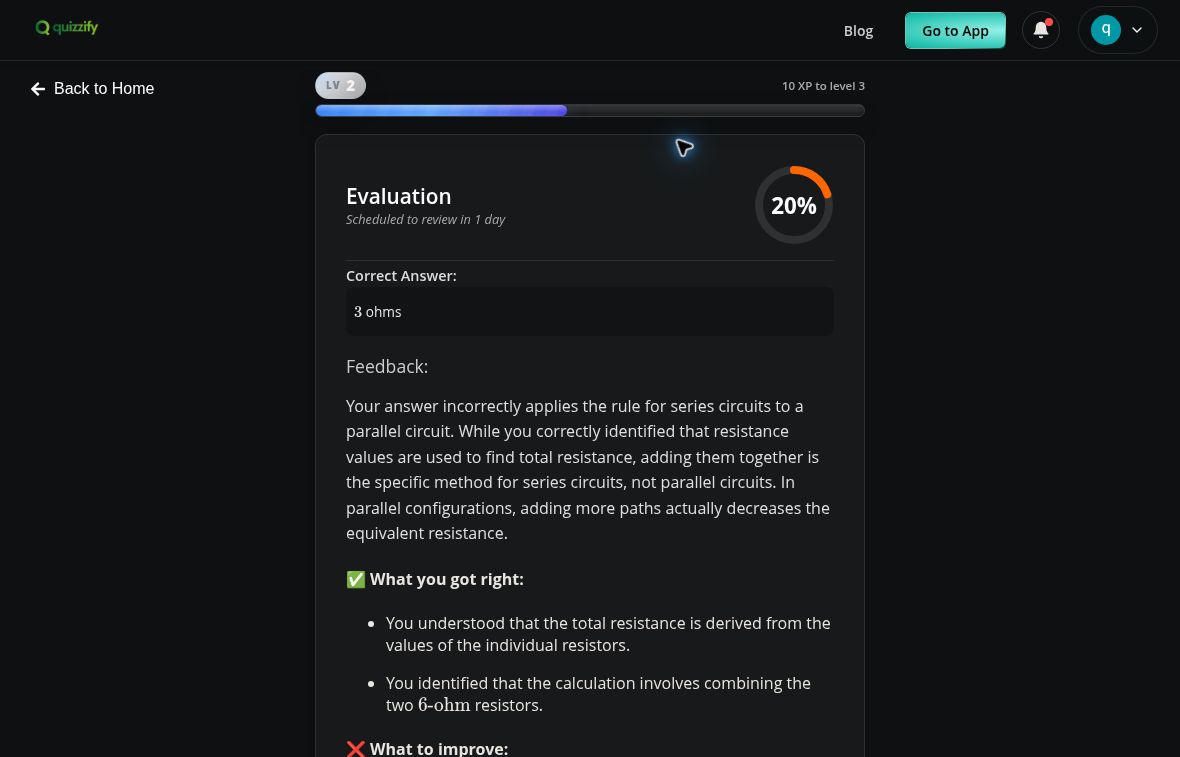
The written-answer result. The screenshot shows the explanation and “What you got right” bullets; the “What to improve” section continues below the captured area.
The explanation was the part I could act on: it pointed to one specific thing to fix before trying again. The 20% is an AI assessment, not a precise measure of understanding, so I'd check the reasoning against my course material.
The summary kept both first attempts
I got both questions right on their retries and scored 100% on each. The end-of-session summary still showed the original 0% and 20%, for an overall score of 78%. The second chance didn't erase the first attempt.
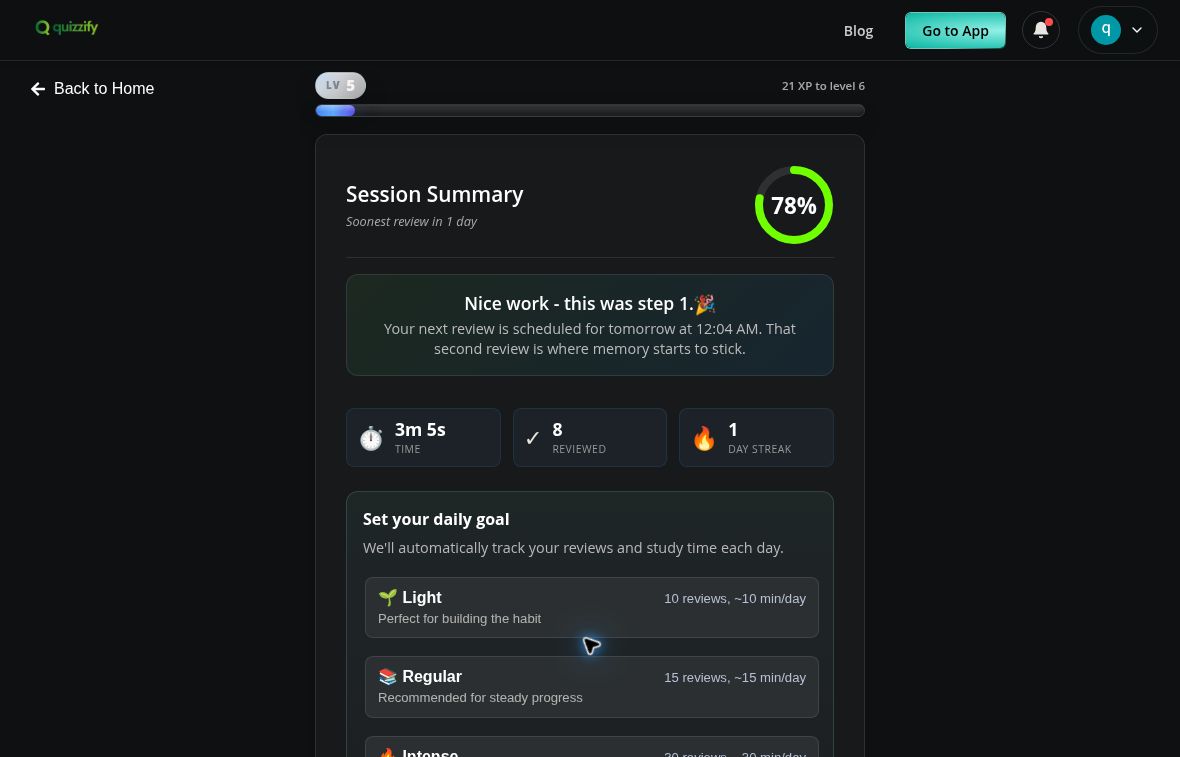
The end of the original eight-card session. The next-review time is a displayed schedule, not evidence of a completed next-day review.
The two missed questions were scheduled for about 24 hours later, and the rest showed three days. The dashboard also displayed a next-review time. I edited one question's wording and saved it without problems, so generated questions can be edited after creation. I didn't test editing a saved set in Quizlet.
Don't read the session scores as a quality comparison. I made two deliberate first-pass mistakes in Quizzify and one in Quizlet, and the apps score answers differently.
How the schedule works after the first review
This part comes from how Quizzify's scheduler is configured, not from my session, where I only saw the first intervals. The default schedule uses each question's scores and review history. A score below 60% sets a one-day interval. Successful reviews start at three days, then six, and later intervals adjust based on performance. There's also a fixed-interval setting if you prefer that.
See the full Quizzify study workflow.
What the comparison actually showed
Both apps caught the mistake, explained it and repeated it, and both offer scheduled review. The difference I could show is narrower:
- Quizzify gives every answer a percentage score, explains it in the same response and uses that score to set the next review, all inside the quiz.
- Quizlet marks each answer in Learn and gives an explanation when you ask for one. Its spaced repetition is a separate Flashcards workflow where you rate your own recall.
If you're happy to judge your own recall, Quizlet's approach works. If you want your answers checked and your review schedule based on the result, that's the routine Quizzify is designed for.
What “free” means in Quizzify
The free plan includes 100 credits a week. Generating a quiz costs 30 credits, and each written-answer evaluation costs one. Three generations use 90 credits, which leaves ten written evaluations if you haven't spent credits on anything else. Other AI features draw from the same allowance.
I'd start by generating a deck from one lecture, checking the questions and spending the rest of the allowance on practice. Along with the multiple-choice, written, true/false and matching questions in my test deck, Quizzify supports case-study questions. Paid options are on the pricing page.
Three other alternatives worth considering
The free plans, limits and platform pricing below were checked against Knowt, Anki and RemNote's official pages on October 17, 2026.
Knowt: my first pick for free Learn-style practice
Knowt's free plan includes unlimited flashcard sets and its core study modes on your own sets: Learn, Practice Test, Spaced Repetition, Match and Flashcards. If losing access to Learn is your main reason for leaving Quizlet, I'd try Knowt first.
Free study modes don't mean unlimited AI, though. Knowt lists one AI summary per month on the free plan. That's fine for drilling a set you already have. If you plan to generate material from every lecture, compare its file-generation limits first.
Anki: for cards you want to keep and customise
Anki gives you control over card layouts and review timing, and it has add-ons and shared decks. You recall an answer, rate how well you remembered it, and Anki schedules the next review. The desktop app and AnkiDroid are free; the official iOS app is paid.
Choose it if you want to build a reliable card collection and keep using it across courses. It's a weaker fit if you just want a quick quiz from a lecture file. That isn't Anki's core workflow, and adding tools to do it means more setup.
Read the full Anki comparison.
RemNote: for notes that become flashcards
RemNote combines notes, flashcards and study tools. Its free plan includes unlimited notes and flashcards, three annotated documents and 250 AI credits per month. Paid plans raise those allowances and add features, so check which AI tools each plan includes.
It suits you if rewriting course notes is already part of how you study and you want cards linked to those notes. If you only want to paste a page and answer a few questions, you probably don't need a full note-taking workspace.
Can you move your Quizlet sets into Quizzify?
Not directly. Quizzify doesn't currently have a Quizlet importer, so pasting a Quizlet URL won't transfer a set. There's a beta importer for Anki .apkg files, but that's a different format.
The practical route is to start from your original notes. Paste the text or upload a supported file, generate a small deck and check the questions. You'll get new questions, not your Quizlet cards or study history. If you need to keep those exactly, check the import instructions for whichever alternative you're considering before you move anything.
My recommendation
- Free Learn-style flashcard practice: start with Knowt. Of the options here, its documented free study modes are the closest match.
- Repeated practice from your own notes: try one lecture in Quizzify. In my test, the score, the explanation, the strengths and improvements, and the next review interval all appeared together, and the summary kept my first mistakes visible. Check the generated answers against your source, and plan around the credit limits.
- Control over a long-term card collection: Anki.
- Cards connected to your notes: RemNote.
- Sets and study modes that already work for your course: stay with Quizlet. In my test, it gave useful feedback, repeated the mistake and offered scheduled review.
One short test can't show which app will do more for your exam grades, and this one doesn't try to.
Try Quizzify with one page of your own notes
FAQ
What is a free alternative to Quizlet Learn?
Knowt includes Learn and its other core study modes free on your own sets. Quizzify is an option if you want practice questions generated from your notes, within a weekly AI credit allowance. Anki suits students who prefer to build or import their own flashcards.
Does Quizlet have spaced repetition?
Yes, in web Flashcards. You rate your recall after revealing each answer, and Quizlet uses that rating to schedule the card. It's separate from Learn's study path.
Does Quizlet accept written answers in your own words?
It can. Relaxed grading accepts meaning, synonyms and rephrasing for eligible sets and languages. Check your grading settings, because not every set uses Relaxed grading by default.
Is Quizzify the same as Quizlet Learn?
No. Learn builds a personalised path around a flashcard set. Quizzify generates a question deck from your notes, then scores your answers, gives feedback, repeats missed questions and schedules reviews. Both are built for repeated practice, but they work differently.
Is Quizzify free?
There's a free allowance of 100 AI credits a week. Generating a quiz costs 30 credits, and evaluating a written answer costs one. Other AI features share the same allowance, so free AI use isn't unlimited.
Can Quizzify import Quizlet sets directly?
No. You can generate a new deck from your own notes, but that won't carry over your Quizlet cards or study history.
Related: Quizzify vs Anki · Penseum alternatives · How to use Quizzify for exams
Related Resources
Keep studying with practical guides and plan details.