
April 24, 2026
Quizzify Study Report: Data From 192,728 Active Recall Reviews
Quizzify Study Report: Data From 192,728 Active Recall Reviews
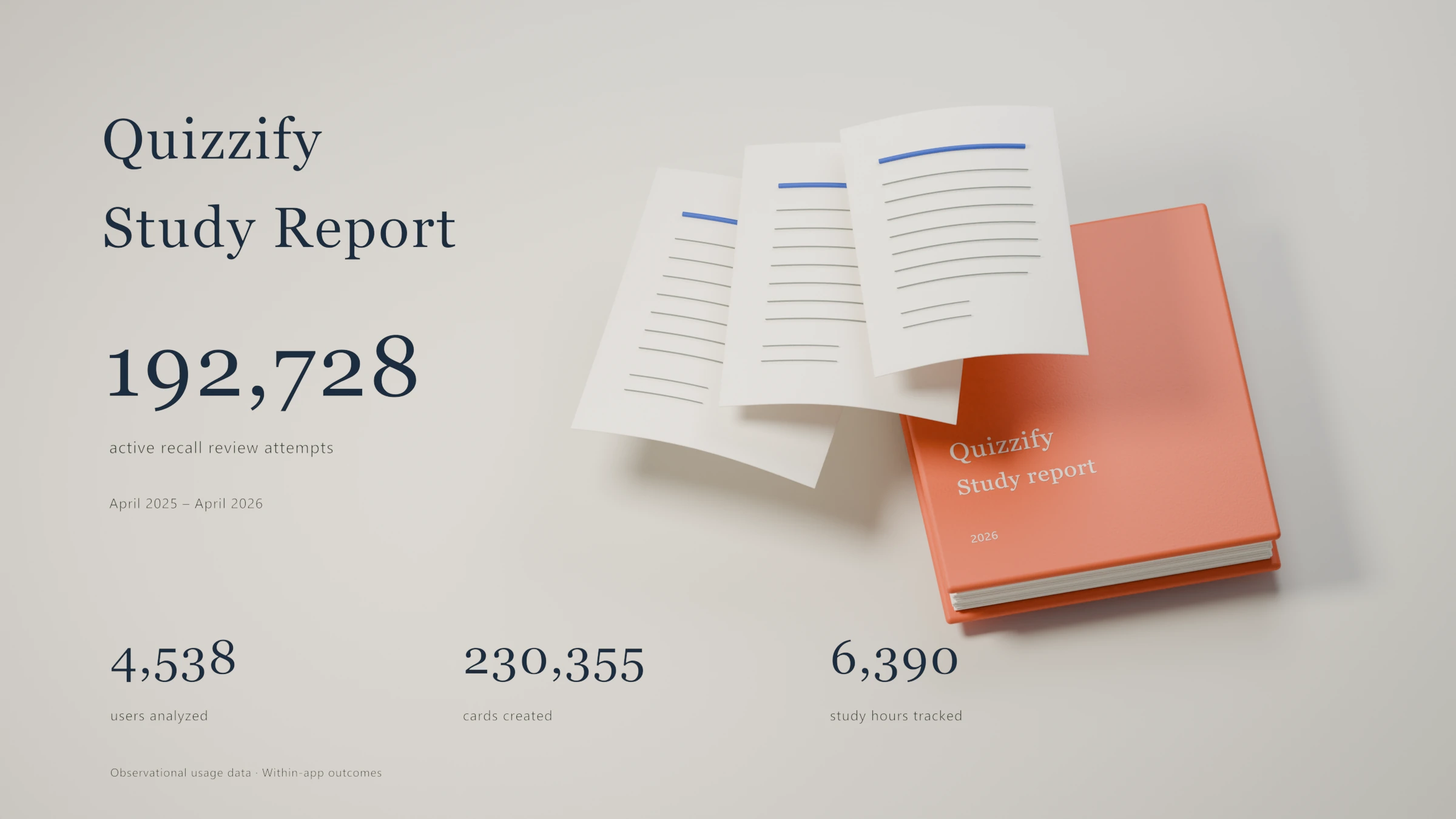
Report summary: This report analyzes anonymized Quizzify usage data from 4,538 users between April 1, 2025 and April 22, 2026. Students created 230,355 study cards, completed 192,728 active recall review attempts, and tracked 6,390 hours of study time. Among cards reviewed more than once, average within-app review scores increased from 66.9 on the first review to 88.6 on the latest review.
This report uses anonymized product usage data, not a controlled classroom experiment. For that reason, the results should be read as evidence of how Quizzify supports repeated active recall in practice, not as proof of grade improvement. The pattern is still clear: students who returned to review cards in Quizzify scored higher on those cards over time, with the strongest gains on cards they initially struggled with.
Key Findings
| Finding | Result |
|---|---|
| Users analyzed | 4,538 |
| Study cards created | 230,355 |
| Active recall review attempts | 192,728 |
| Users who completed at least one review | 2,595 |
| Cards reviewed more than once | 32,649 |
| Average first score on repeated cards | 66.9 |
| Average latest score on repeated cards | 88.6 |
| Average score change on repeated cards | +21.6 points |
| Study sessions tracked | 43,508 |
| Total study time tracked | 6,390 hours |
The strongest pattern in the data was improvement on weak cards. Cards that initially scored under 50 improved from an average first score of 3.7 to an average latest score of 80.4 after repeat review.
About Quizzify
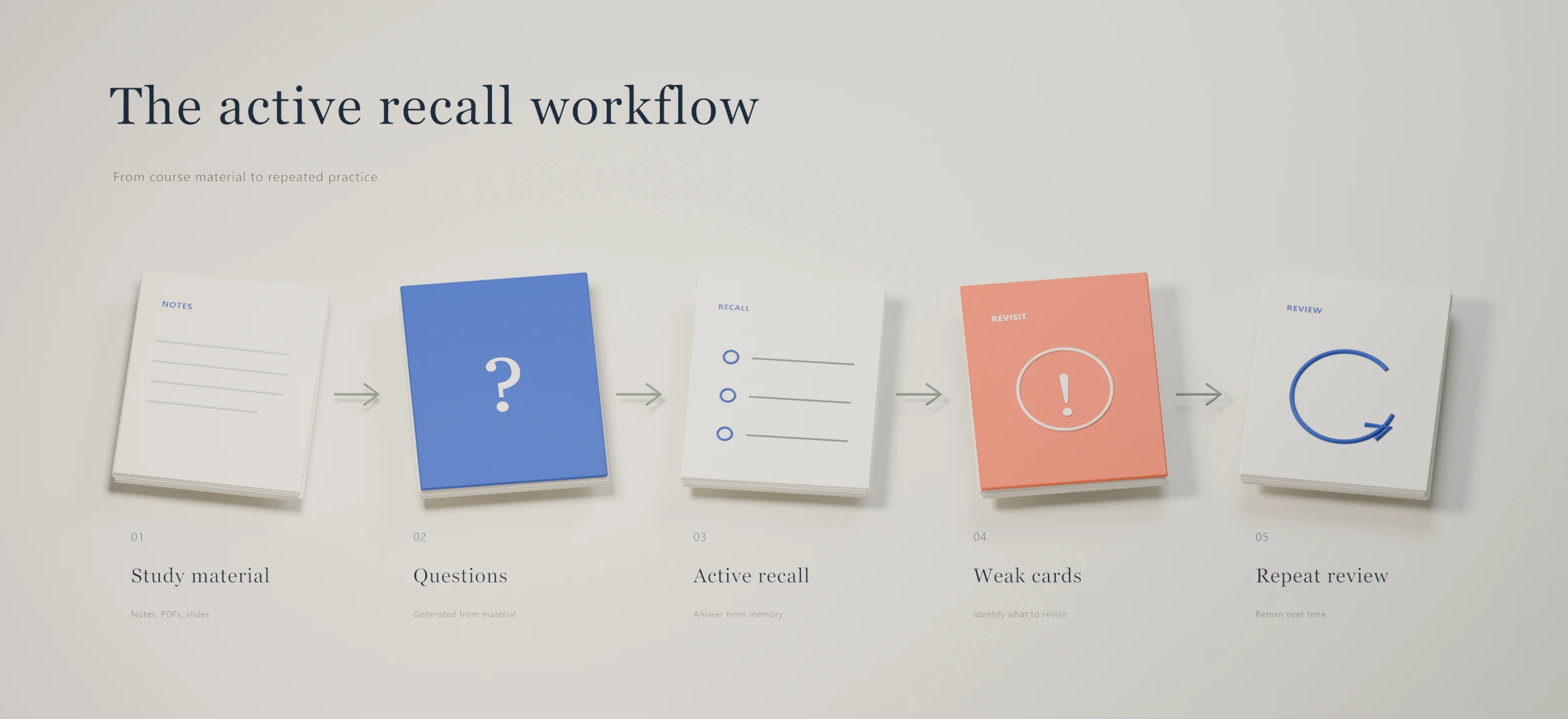
Quizzify is an AI study tool that helps students turn notes, PDFs, slides, textbook photos, and pasted text into practice questions. Students can then study those questions with active recall, review weak cards again over time, and track study sessions.
The product is built around three study behaviors:
- creating practice questions from existing study material
- answering questions from memory with active recall
- returning to weak material through repeated review
This report focuses on how students used those study behaviors inside Quizzify.
Dataset
The analysis covers anonymized Quizzify usage from April 1, 2025 to April 22, 2026.
| Metric | Result |
|---|---|
| Users analyzed | 4,538 |
| Quiz decks created | 8,075 |
| Study cards created | 230,355 |
| Active recall review attempts | 192,728 |
| Users who completed at least one review | 2,595 |
| Study sessions tracked | 43,508 |
| Total study time tracked | 6,390 hours |
No emails, names, uploaded documents, raw answers, private notes, or generated question text were used in this public report.
Finding 1: Students Created 230,355 Study Cards
Students created 230,355 study cards across 8,075 quiz decks.
This matters because many students struggle to move from passive review into practice. Rereading notes, highlighting slides, and watching videos can make information feel familiar, but those methods do not always test whether a student can recall the answer without looking.
In Quizzify, students used AI to turn study material into questions they could answer from memory. This made it easier to begin active recall without manually writing every question first.
Finding 2: Repeated Reviews Were Associated With Higher Scores
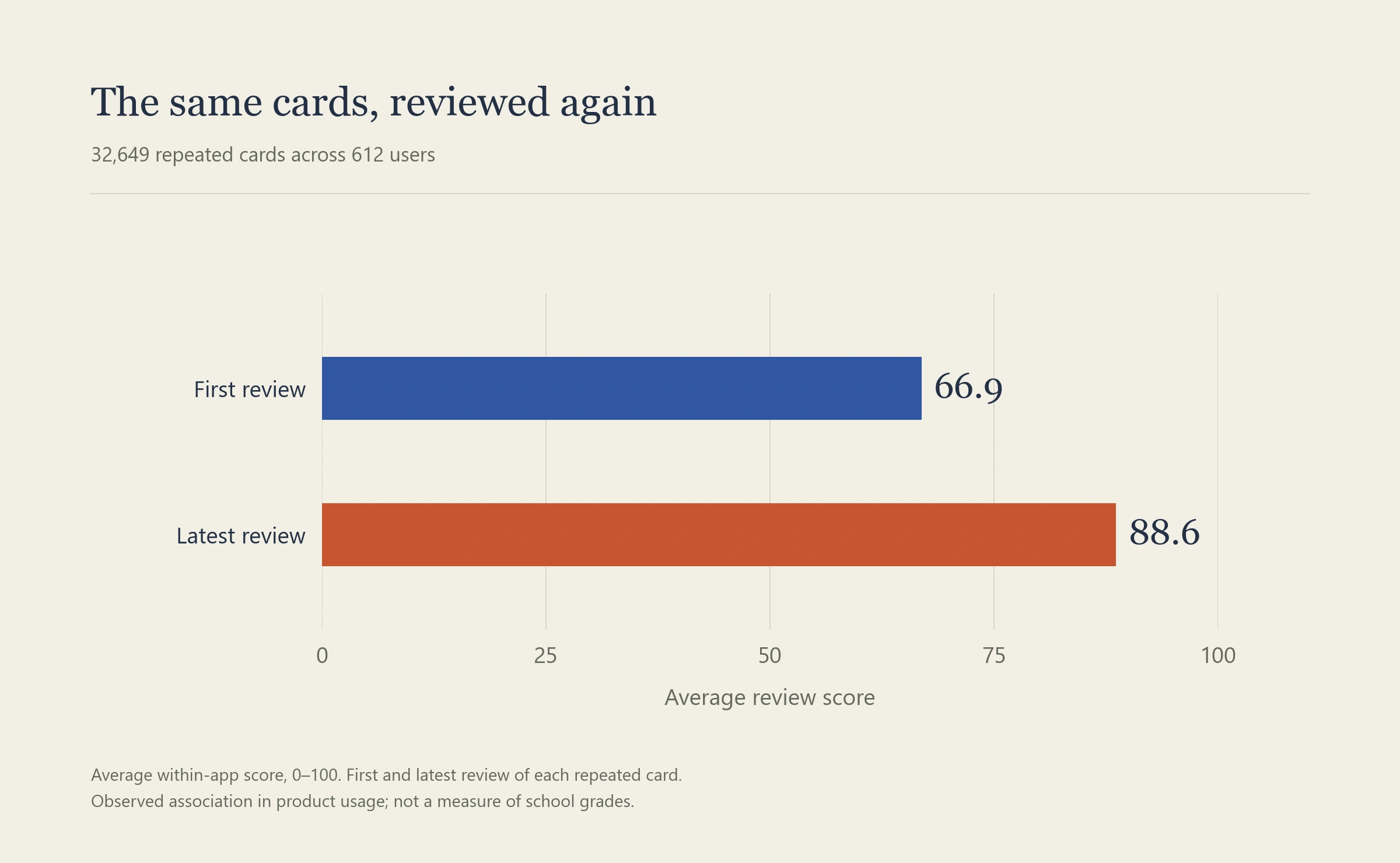
Among cards reviewed more than once, average scores increased substantially.
| Metric | Result |
|---|---|
| Cards with repeat reviews | 32,649 |
| Users with repeat reviews | 612 |
| Average first score | 66.9 |
| Average latest score | 88.6 |
| Average score change | +21.6 points |
These are within-app review scores, not school grades. Within the product, the pattern was clear: when students returned to review the same cards again, their performance on those cards was higher on average.
The data supports a practical study principle: generating practice questions once is less useful than returning to those questions and trying to retrieve the answers again.
Finding 3: Weak Cards Improved The Most
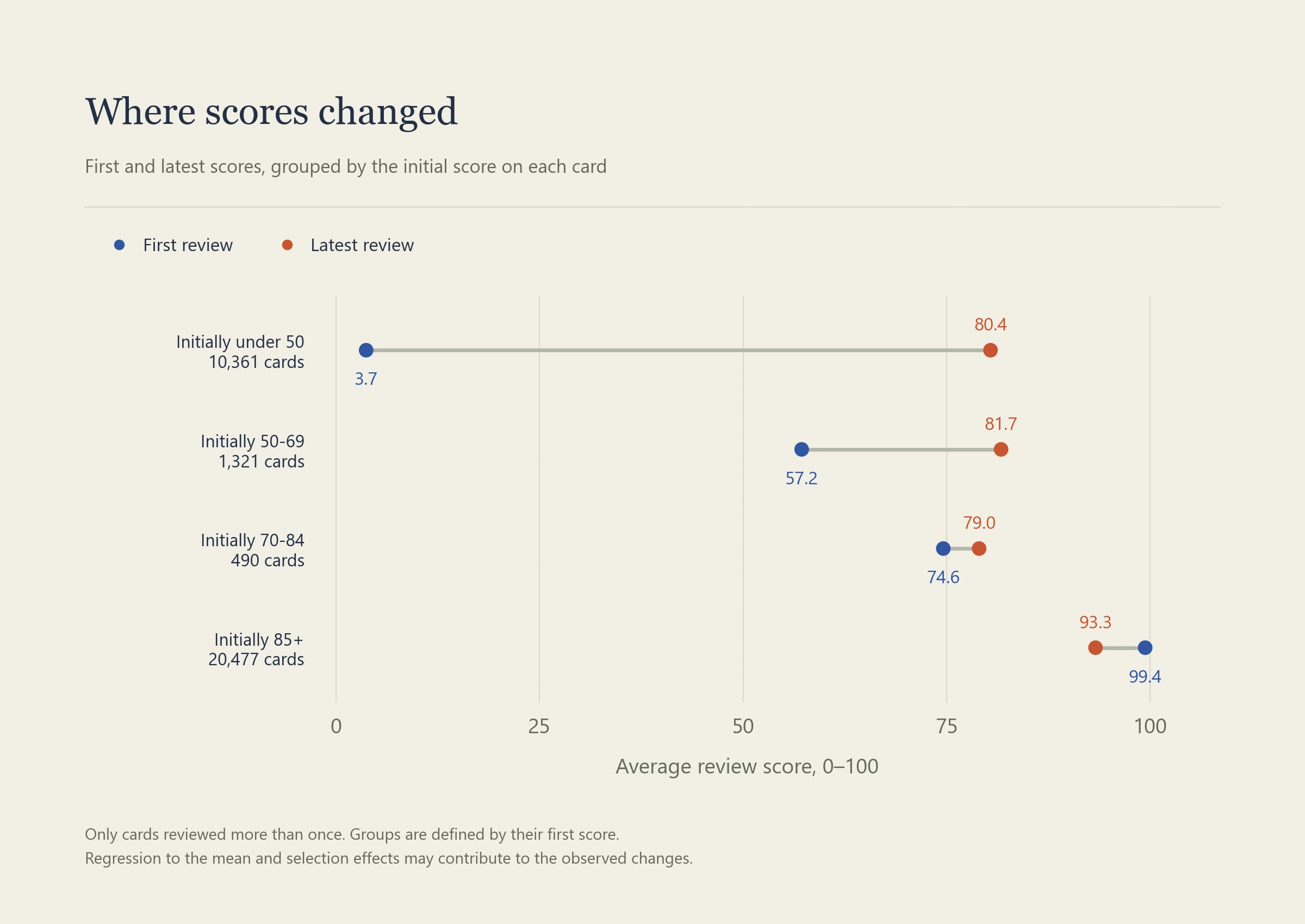
The largest improvement appeared on cards students initially struggled with.
| Initial Score Bucket | Repeated Cards | Avg First Score | Avg Latest Score | Avg Change | Latest Score 70+ |
|---|---|---|---|---|---|
| Initial score under 50 | 10,361 | 3.7 | 80.4 | +76.7 | 78.9% |
| Initial score 50-69 | 1,321 | 57.2 | 81.7 | +24.5 | 75.5% |
| Initial score 70-84 | 490 | 74.6 | 79.0 | +4.4 | 79.8% |
| Initial score 85+ | 20,477 | 99.4 | 93.3 | -6.0 | 93.2% |
The "initial score under 50" group had a very low average first score because it included cards students missed badly on the first review. In a study app, this is expected: complete misses are exactly the cards students need to identify and revisit.
Cards that began below 50 improved to an average latest score of 80.4 after repeat review.
This suggests Quizzify was especially useful for identifying weak material and giving students a way to practice that material again.
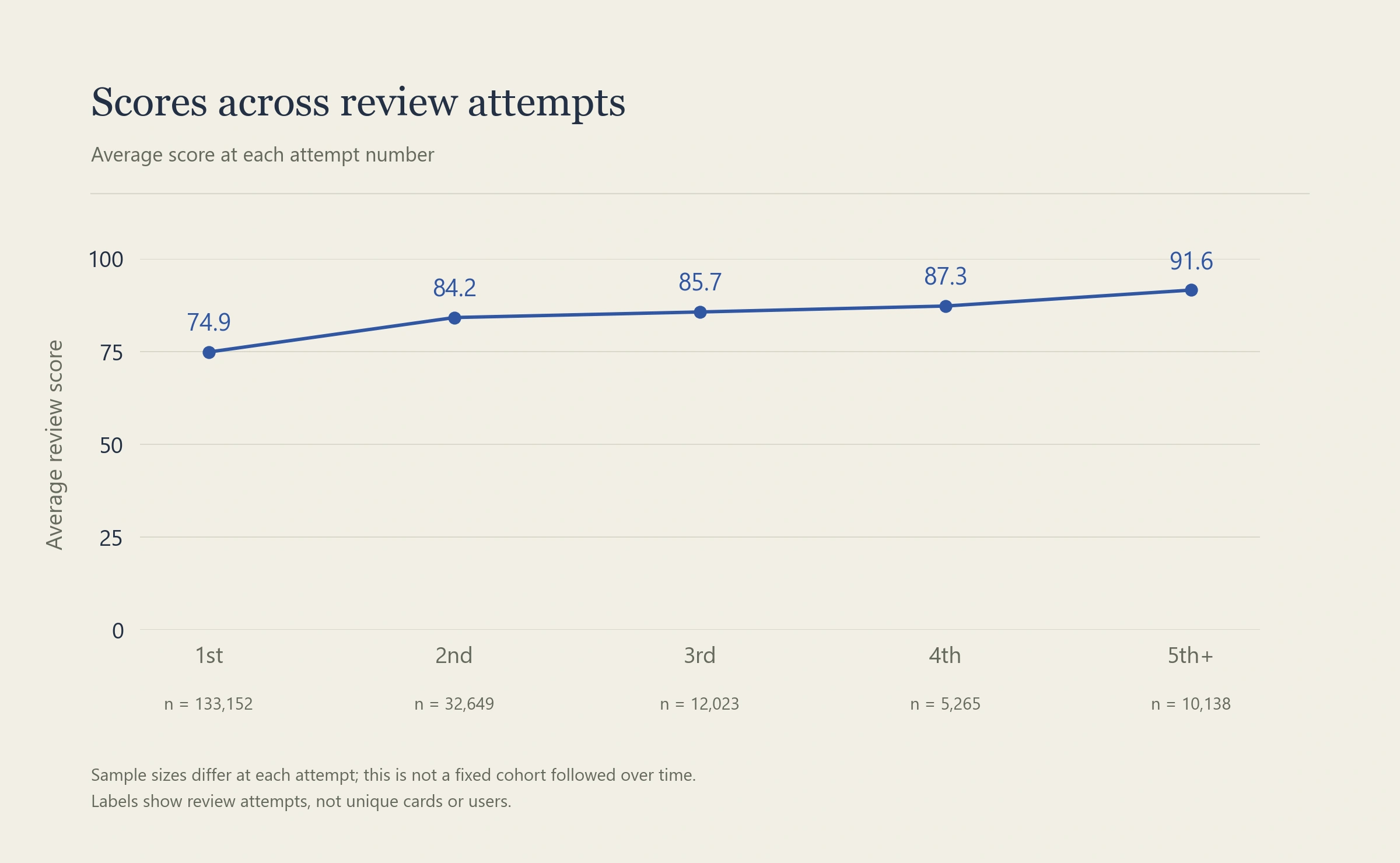
Finding 4: Scores Increased Across Repeated Attempts
Average scores rose as students completed more review attempts.
| Attempt | Review Attempts | Users | Average Score |
|---|---|---|---|
| 1st attempt | 133,152 | 2,623 | 74.9 |
| 2nd attempt | 32,649 | 612 | 84.2 |
| 3rd attempt | 12,023 | 269 | 85.7 |
| 4th attempt | 5,265 | 136 | 87.3 |
| 5th+ attempt | 10,138 | 82 | 91.6 |
This pattern is consistent with a repeated active recall workflow. Students were not only generating study cards. When they returned for additional reviews, average performance increased.
Finding 5: Review Gaps Were Associated With Score Changes
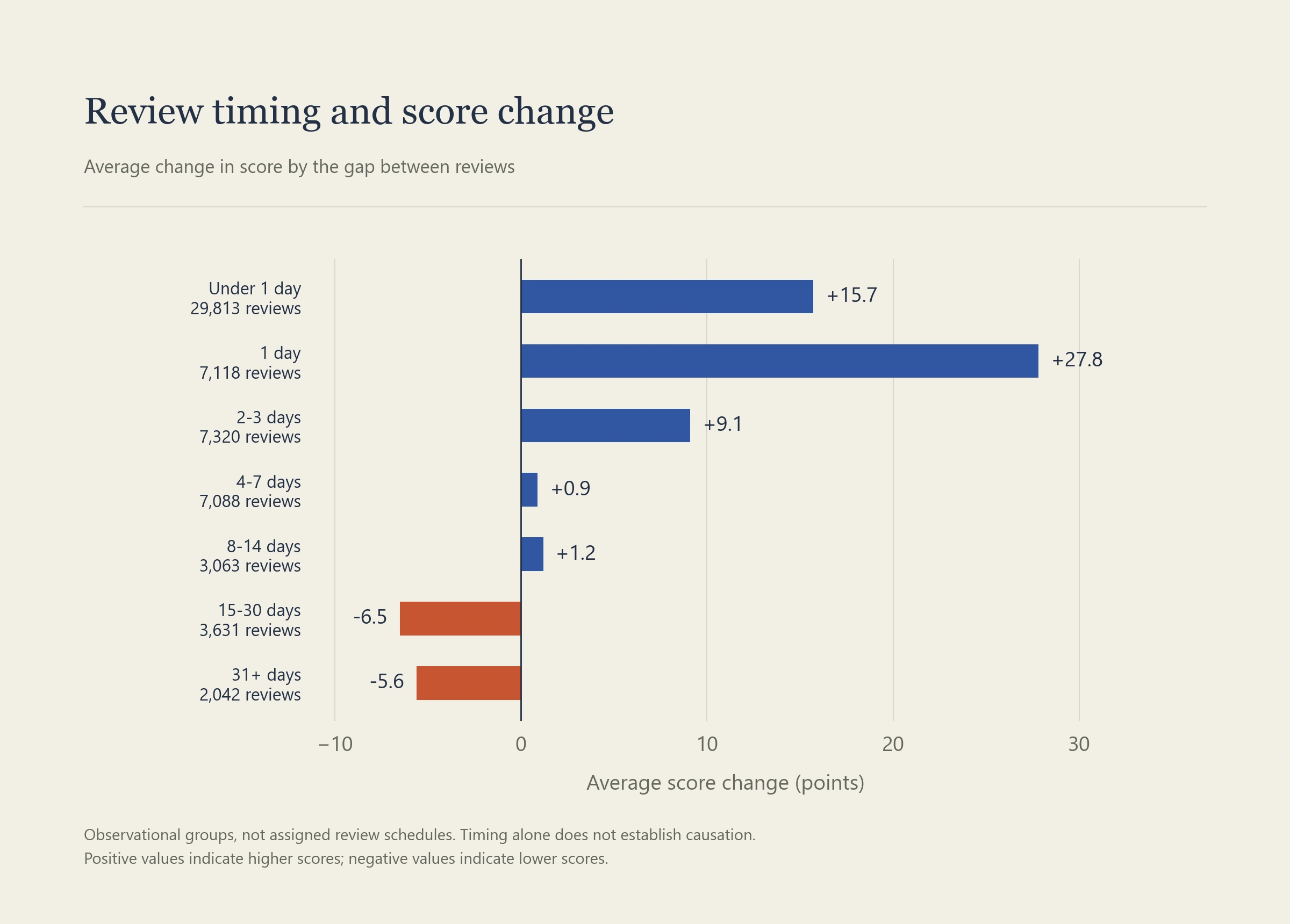
When students reviewed the same card again, review timing was associated with different score changes.
| Review Gap | Repeated Reviews | Average Score Change |
|---|---|---|
| Under 1 day | 29,813 | +15.7 |
| 1 day | 7,118 | +27.8 |
| 2-3 days | 7,320 | +9.1 |
| 4-7 days | 7,088 | +0.9 |
| 8-14 days | 3,063 | +1.2 |
| 15-30 days | 3,631 | -6.5 |
| 31+ days | 2,042 | -5.6 |
The strongest average score change appeared after a 1-day review gap, not after reviewing again in under 1 day. Reviews under 1 day were still associated with positive score changes, but the average gain was lower than the 1-day group.
This is a useful practical finding: immediate same-day review may help, but coming back the next day appeared stronger in this dataset. That fits the idea behind spaced repetition: students benefit from allowing some time to pass before retrieving the same material again.
This does not mean a 1-day gap is the best interval for every student or subject. Review timing may be affected by motivation, exam schedules, card difficulty, and other study behavior. Still, the pattern is useful: long gaps were linked with weaker score changes in this dataset.
Interpretation
The data points to three practical conclusions:
- Students used Quizzify to create active recall material at scale.
- Students scored higher on cards they reviewed repeatedly.
- Weak cards showed the strongest improvement after repeat review.
The findings support Quizzify's core study workflow: generate practice questions from real study material, answer from memory, identify weak cards, and review those cards again over time.
The report shows Quizzify supporting a repeatable active recall workflow in real product usage. Students created questions from study material, reviewed those questions, identified weak cards, and came back to practice them again. Across those repeated reviews, scores rose substantially.
Connection To Learning Science
Quizzify's workflow is based on study methods supported by cognitive science.
Practice testing, also called retrieval practice, helps students strengthen memory by trying to recall information instead of only rereading. Roediger and Karpicke found that taking memory tests can improve long-term retention compared with restudying alone.
Spaced repetition is based on distributed practice: reviewing material across time instead of cramming it all at once. Cepeda et al. reviewed hundreds of assessments on distributed practice and found that spacing study episodes affects later retention.
Dunlosky et al. rated practice testing and distributed practice as high-utility learning techniques because they generalize across many learners, materials, and tasks.
Quizzify applies these ideas in a product workflow: create questions, test recall, identify weak material, repeat reviews, and track study time.
Methodology
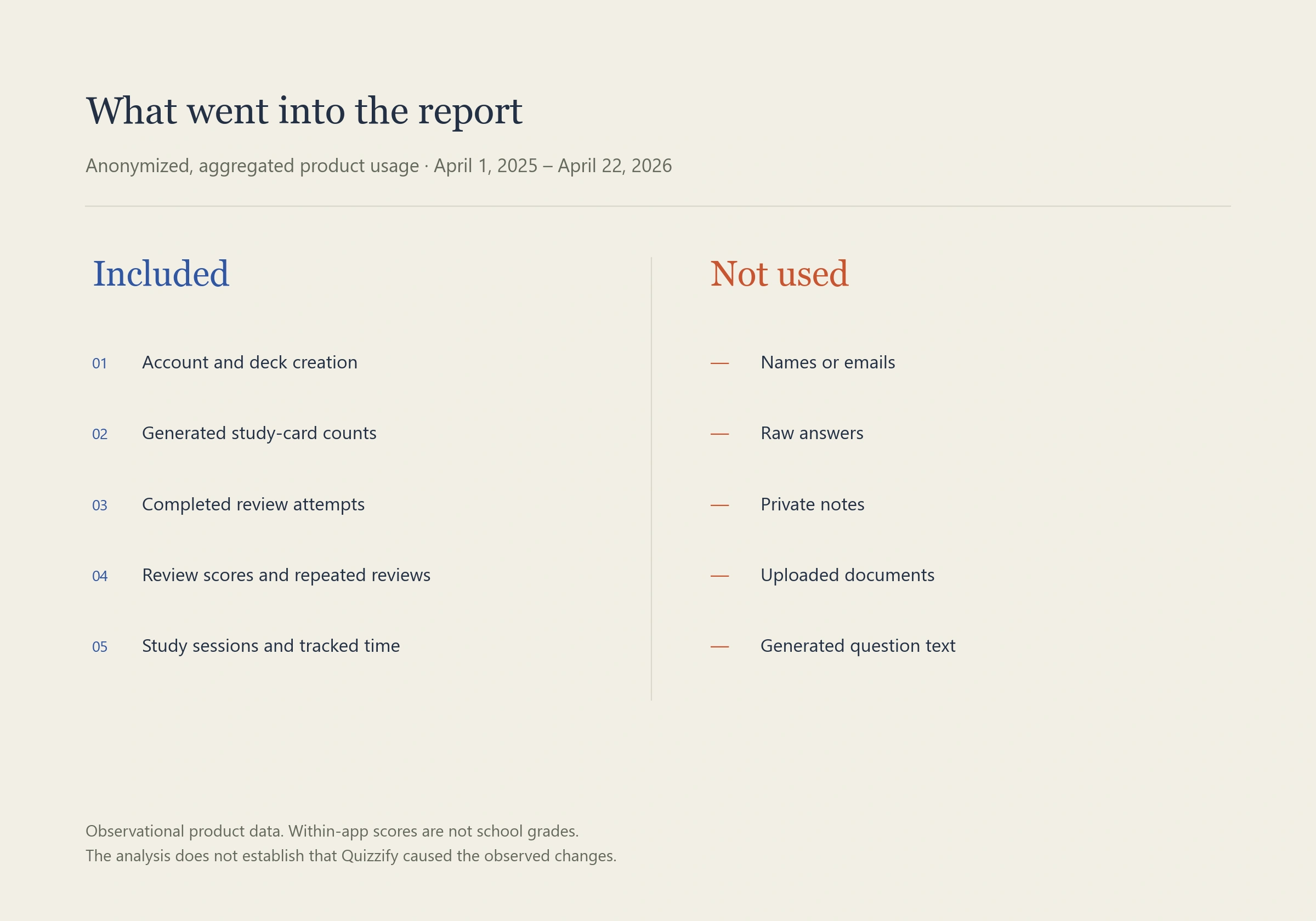
This report analyzed anonymized Quizzify usage data from users who signed up between April 1, 2025 and April 22, 2026.
The analysis included:
- account creation
- deck creation
- generated study cards
- completed review attempts
- repeated card reviews
- review scores
- study sessions
- tracked study time
A "review attempt" means a completed Quizzify review event for a quiz card.
A "repeated card" means the same user reviewed the same card more than once.
Score changes compare the first and latest recorded score for cards with repeat reviews.
Privacy
This public report did not use:
- names
- emails
- raw answers
- private notes
- uploaded documents
- generated question text
The report uses aggregated product usage metrics only.
Limitations
This analysis uses anonymized product usage data, not school grades or official exam results. The score changes reported here are Quizzify review scores.
Because this is product usage data rather than a controlled classroom experiment, the results should be interpreted as evidence of how students used Quizzify in practice. Students who return for more reviews may also be more motivated, more consistent, or using other study methods at the same time.
Review-score gains may also reflect regression to the mean, especially for cards that began with very low scores. Very weak cards have more room to improve than cards that already began near the top of the scoring range.
How To Cite This Report
Suggested citation:
Quizzify. "Quizzify Study Report: Data From 192,728 Active Recall Reviews." Quizzify Blog, 2026.
Useful summary:
In anonymized Quizzify usage data from 4,538 users, students completed 192,728 active recall review attempts. Cards reviewed more than once improved from an average first score of 66.9 to an average latest score of 88.6, while cards initially scoring under 50 improved to an average latest score of 80.4 after repeat review.
FAQ
What did the Quizzify study report analyze?
The report analyzed anonymized Quizzify usage data from 4,538 users between April 1, 2025 and April 22, 2026, including study cards created, review attempts, repeated reviews, review scores, study sessions, and study time.
What was the main finding?
Among cards reviewed more than once, average within-app scores increased from 66.9 on the first review to 88.6 on the latest review.
Did Quizzify prove it improves grades?
No. This report analyzes within-app review scores, not school grades or official exam results. It shows that students who repeatedly reviewed cards in Quizzify scored higher on those cards over time.
Which cards improved the most?
Cards students initially struggled with improved the most. Cards with an initial score under 50 improved from an average first score of 3.7 to an average latest score of 80.4.
What study methods does Quizzify use?
Quizzify uses active recall, practice testing, spaced repetition, study-time tracking, and AI tutoring to help students identify weak areas and review them over time.
Sources
- Dunlosky et al., 2013: Improving Students' Learning With Effective Learning Techniques
- Roediger & Karpicke, 2006: Test-enhanced learning: taking memory tests improves long-term retention
- Cepeda et al., 2006: Distributed practice in verbal recall tasks
Learn more about Quizzify at quizzify.ca.
Related Resources
Keep studying with practical guides and plan details.